Recent Posts
The hidden cost of reactive decision-making.
Oct 2026
Measuring AI success beyond cost savings.
Sep 2026
Why connected intelligence beats connected systems.
Aug 2026

Every organisation talks about data.
More data. Better data. Real-time data.
Yet despite unprecedented investment in sensors, analytics platforms and AI, many organisations still struggle to make confident operational decisions. The problem is rarely the volume of information available. More often, it is whether people trust it.
Trusted data is not simply accurate data. It is data that people believe, understand and are willing to act upon.
That distinction matters more than ever.
In operational environments, decisions are made under pressure. Whether it’s a control room operator responding to an emerging incident, a logistics manager rerouting freight, or an executive deciding where to allocate resources, there is rarely time to validate every data source.
People rely on information they trust.
When that trust exists, decisions happen quickly and confidently.
When it doesn’t, something predictable occurs. Teams cross-reference multiple systems. They seek reassurance from colleagues. They rely on experience rather than evidence. Valuable time is lost while confidence is rebuilt.
Technology may have accelerated, but human behaviour has not changed.
For frontline teams, trusted data means confidence that what they are seeing reflects operational reality.
Alerts are relevant. Recommendations are timely. Information arrives when it matters and is consistent with what they observe on the ground.
This reduces cognitive load. Instead of questioning the information, operators can focus on taking action.
For leaders, trust extends beyond individual events.
Executives need confidence that strategic decisions are being made against a complete understanding of the organisation. They need to know that operational reports reflect reality rather than disconnected snapshots from different departments.
Without this shared understanding, competing versions of the truth emerge. Different teams optimise different objectives, often unintentionally working against one another.
Trusted data creates alignment.
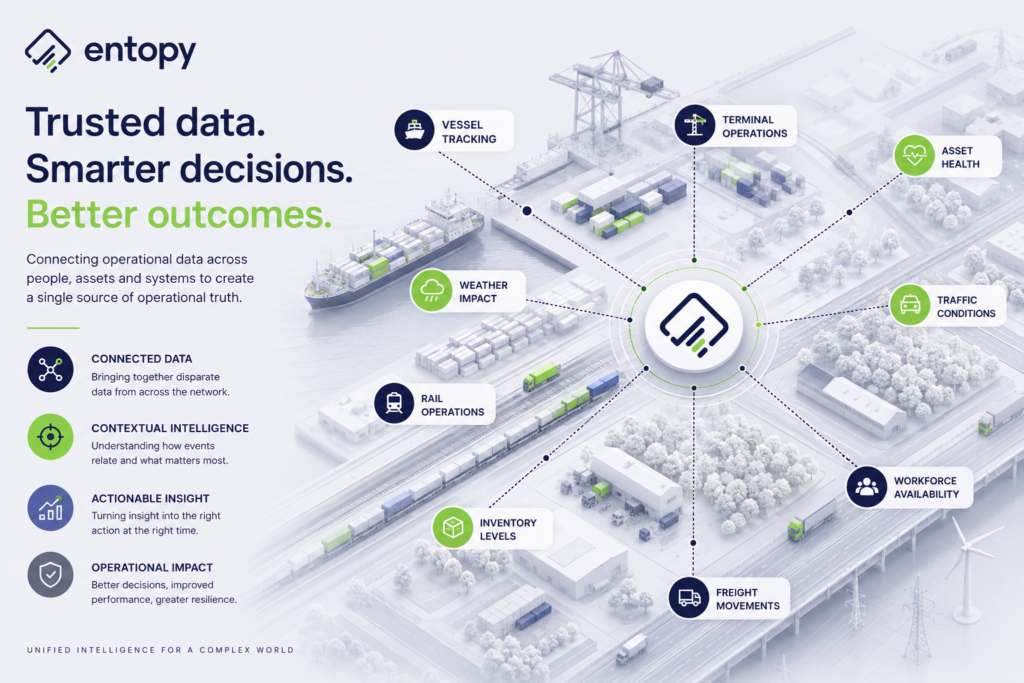
One of the biggest misconceptions is that trust is achieved simply by improving data quality.
Clean data is essential, but it is not enough.
A delayed vehicle. A changing weather forecast. An unavailable asset.
Each of these may be perfectly accurate, but none explains whether it matters.
Context transforms information into understanding.
It explains how events relate to one another, how they affect operational constraints, and what consequences may emerge next. When people understand why something is happening, trust increases naturally.
This is why context has become one of the defining challenges of operational AI.
As organisations increasingly introduce AI into operational decision-making, trust becomes even more important.
If recommendations cannot be explained, people will ignore them.
If alerts generate unnecessary noise, people will switch them off.
If outputs contradict operational experience without explanation, confidence disappears.
Successful AI therefore isn’t measured by how much information it produces. It’s measured by how consistently it helps people make better decisions.
The organisations seeing the greatest value from AI are not those generating the most insights. They are those creating intelligence that is transparent, explainable and grounded in operational reality.
The next generation of operational excellence will not be defined by who collects the most data.
It will be defined by who trusts it.
That trust doesn’t come from dashboards or algorithms alone. It comes from creating a shared understanding of how an operation is behaving, why it is changing, and what action should be taken next.
When frontline teams and leadership operate from the same trusted picture of reality, decisions become faster, coordination improves, and organisations become significantly harder to surprise.
In increasingly complex operational environments, trusted data is no longer just an IT objective.
It is a strategic advantage.
