Recent Posts
Decision-making horizons: Horses for courses.
Jan 2026
Unified intelligence: Your operational decision layer.
Dec 2025
How AI and Digital Twins are powering smarter port operations.
Dec 2025

Decision intelligence is gaining momentum. It’s easy to understand why. Increasingly, businesses are looking to technology to provide decision support due to the complexity, frequency and nature of the decisions they are subject to on a day-to-day basis.
The challenge though, is that different decisions have different requirements and this is fundamental to the type of decision intelligence required. The chart below illustrates a decision horizon matrix. The X-axis illustrates the decision horizon. Real-time ops decisions (mobilisation of traffic management controls, changes to plans or schedules, etc.) have a much shorter horizon than transformational decisions (infrastructure investments, purchase of new equipment, etc.). The Y-axis then represents the ‘freshness’ of the intelligence required – essentially, how dynamic does it need to be.
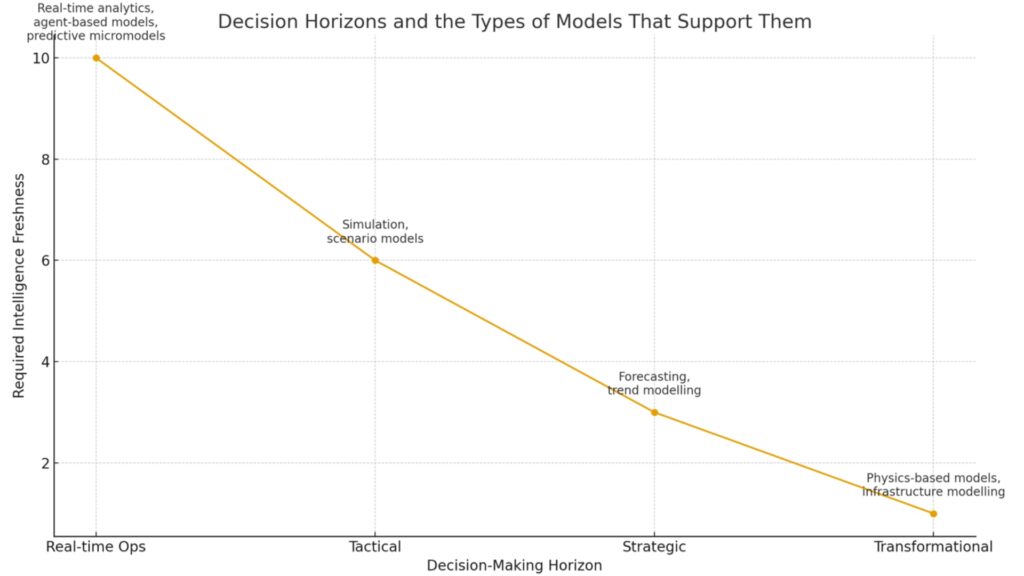
For the longer-horizon decisions, models such as static physics/rules/science-based models are more than sufficient. These are typically models of high fidelity and are developed over months/years by subject matter experts (SMEs). These models are rules based. When inputs go in, they are subject to the model rules which derive outputs. If you are building a housing development and you require a transport plan, the modelling requirement you must meet the planning application illustrates this profile perfectly.
For strategic decisions, forecasts are sufficient. These are high-fidelity mathematical models that generally look similar to the physics-models only, they simply need to forecast, not model real-world interactions. Think back to COVID. The ‘R’ number was a mathematical forecast. These models are designed to shape strategic direction and help but are not updated at a high frequency so again, fit the profile of strategic decision-making.
Then you get to tactical modelling where you may want to test ‘what-if’ scenarios are a relatively moderate frequency. Say you must decide staffing plans in a week’s time, a rules-based simulation of different staffing levels factoring flow and processing rates will help to make those types of decisions.
Then you get to real-time ops where the decision-making horizons are much shorter. Now, if you live in a vacuum where nothing changes, running real-time operational decisions on a physics-model, a forecast or a rules-based simulation would be fine. However, that’s not how the world works. Weather changes, operational shifts, geo-political events will have a material impact on the intelligence required and the ultimate decision. For this, you need an integrated network of real-time predictive models, orchestrated with real-time data, integrated with rules based or physics-based logic with access to large knowledge banks. For this, you need a much more sophisticated operational decision layer.
Operational decision layer platforms such as Entopy deliver this level of intelligence. Data is continuously integrated maintaining a live picture. AI Micromodels ingest this data and update predictions minute-by-minute. These feed into workflows where logic is applied to adjust predictive outputs. And LLM’s sit atop leveraging the underlying intelligence and combining with wider knowledge bases such as the open internet and specific documentation.
The key thing is that the operational decision layer can move across the decision-making horizons, to support tactical, strategic and transformational decision making whereas technologies in those layers cannot move backwards. Think about it like this. You can zoom out but you can’t zoom in.